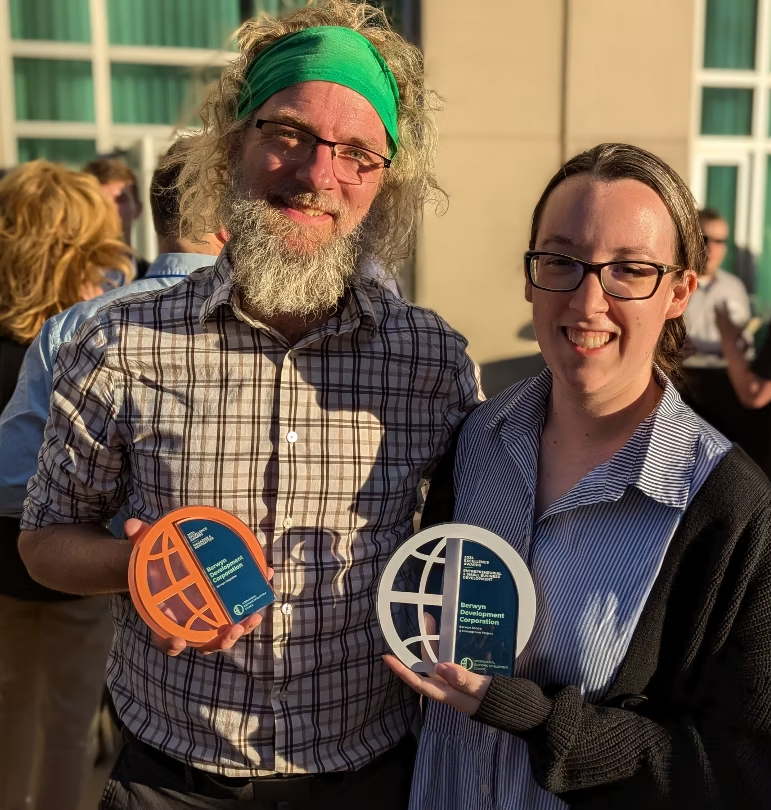
If you’ve patronized the Brookfield Shops at Progress Park, or if you got excited by the news of a potential Riverside Shops program, or if you’ve even visited the Berwyn Shops along Roosevelt Road, then you’ve been on the receiving end of the work done by Kendra Shaw and Patrick Greenacre, the founders of KPGS Consulting.
KPGS is the company that multiple municipalities in the region, including Brookfield and Riverside, have contracted with to create retail incubator programs from the ground up.
“We absolutely love supporting small businesses. Our combined passion [is] seeing them grow, not just as a business learning their craft but a business learning business basics,” Shaw said. “That passion is what keeps us together as a business. It’s fun to see each community figure out how the incubator could work in their space, how it could be different than others and what they need in their community.”
The pair first met when Greenacre was hired on at the Berwyn Development Corp., where Shaw already worked. He described the circumstances that led to the creation of KPGS as “serendipitous.”
“The project of a retail incubator popped up. With my background in marketing, I had never really done anything like this, but it was an exciting, cool opportunity. Kendra and I were tasked with taking the lead on it,” he said. “After the first season of the incubator, Kendra and I found ourselves talking a lot about how cool it would be to get some more of these going in different areas.”
While they didn’t invent the retail incubator model, the duo said it has spread in popularity due to its flexibility.
“In general, retail incubators are meant to help businesses figure out their next steps in a way that lowers barriers to access to a storefront. An incubator, in theory, is more affordable, has more training, and it really is a wraparound service program for a business to figure out if what they do, maybe as a side hobby or [at] pop-ups would work full-time,” Shaw said. “We saw some struggles, especially with the pandemic, of vacant properties going up, but businesses also [being] concerned about taking that leap into a storefront. I think incubators are a way to help bridge that gap.”
Greenacre said he believes the involvement of municipalities is also key to a retail incubator.
“They see the value. They want businesses that are going to be successful, that move into their space. You could be an excellent candlemaker but have no idea how to make a website, or you could be an amazing bread baker and have no idea how to balance your books. It’s never that businesses fail because their products are awful; it’s usually some sort of education and learning that holds businesses back,” he said. “One of the things that Kendra and I always push with the municipalities is that training is incredibly important.”
As the Brookfield Shops head into their second year, the duo said they’ve been “overwhelmed” by Brookfield’s response to the incubator program.
“It doesn’t just work if we love the businesses or the village loves the businesses. It really only works if the community falls in love with them and wants to go back to see their products over and over,” Shaw said. “We’ve had so many events on-site, a lot of collaborations with partners like the Chamber [of Commerce] and the village and the local theater group. The fact that all of those partners volunteered to be part of it is great.”
Each of them named a different part of the KPGS formula that keeps them coming back.
“Never once did I think I would be interested in city zoning code and business licenses and the processes behind all that. That’s the stuff that I get to learn. I get to learn every single day. Each municipality that we work with, they all have their opportunities to do something different. They all want to be a little bit different. Even though the frame and the skeleton of the program is relatively similar, that’s about where it ends,” Greenacre said.
Shaw said her favorite part of the work is getting to see the vendors themselves evolve.
“We’re seeing small business owners graduate out of this type of program into storefronts, or graduate out of the program, realize this isn’t the path for them, and either go back to online sales or farmers markets or really do their own thing. I love the fact that they get to make that decision and figure out their next step without the cost of doing a full-time lease,” she said. “I get to befriend a bunch of cool artisans that are incredibly talented, and I have no idea how they do any of the things that they do. To see them grow and get almost progress reports, it feels like I’ve adopted them all. To hear back from them with all the things that they’re doing in the future is really cool.”